AI is transforming the workplace at an unprecedented pace. But according to SHRM CHRO Jim Link, the greatest opportunity is not replacing people with technology. It is helping people become better leaders. On Rebels with a Heart, Jim and LifeGuides CEO Derek Lundsten explored why leadership, manager readiness, and employee well-being are more important than ever.
AI is reshaping how work gets done and what employees need from their leaders.
Organizations are racing to understand how AI will reshape jobs, improve productivity, and transform the employee experience. New technologies seem to emerge almost daily, promising greater efficiency, faster decision-making, and entirely new ways of working.
But amid all the excitement—and anxiety—one question often gets overlooked: What becomes more important as technology becomes more powerful?
That question sat at the heart of a recent episode of the Rebels with a Heart podcast featuring Jim Link, CHRO of SHRM, and Derek Lundsten, CEO of LifeGuides.
While much of today's AI conversation focuses on automation and disruption, Link offered a refreshingly different perspective. Rather than viewing artificial intelligence as a replacement for people, he believes organizations should see it as an opportunity to elevate distinctly human capabilities such as communication, coaching, judgment, and leadership.
"We are not asking the right questions here about the capability that artificial intelligence can bring into the workplace for us." — Jim Link
For HR leaders, that shift in thinking has profound implications.
The future of work isn't simply about adopting new technology. It's about preparing people to lead differently in a workplace that is becoming increasingly dynamic, complex, and human-centered.
AI Isn't Replacing People. It's Raising Expectations.
Watch: AI + HI: From Fear to Superpower
One of the biggest misconceptions surrounding AI is that it represents a competition between people and machines. Link argues that's the wrong way to think about it. Organizations should instead focus on how AI can enhance human capability rather than replace it: "Instead of worrying about how AI is going to take your job or not take your job, we should instead be thinking about what artificial intelligence can do for us in the way that we think about the world of work."
It's a perspective that aligns with a growing body of research. According to Microsoft's 2025 Work Trend Index, organizations are preparing for AI by investing in both technology and people. When respondents ranked the workforce strategies their teams or organizations were most likely to pursue over the next 12 to 18 months, 47% placed AI-specific skilling for the existing workforce among their top three priorities. Another 45% prioritized maintaining headcount while using AI as digital labor.
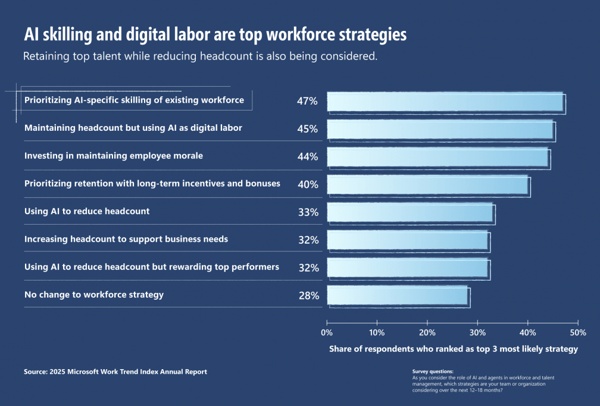 Source: 2025 Microsoft Work Trend Index Annual Report
The people-centered priorities were nearly as prominent. Forty-four percent ranked maintaining employee morale among their top three strategies, while 40% prioritized retention through long-term incentives and bonuses. By comparison, 33% ranked using AI to reduce headcount among their top three likely strategies.
That mix of priorities tells an important story. Organizations expect AI to expand capacity and change how work gets done, but they still recognize that successful adoption depends on whether employees have the skills, confidence, motivation, and support to work differently. AI transformation is not only a technology initiative. It is also a leadership, talent, and change management challenge.
SHRM Research Shows Why the Human Side of AI Matters
New research from SHRM's Navigating AI in the Workplace: 2026 report reinforces the importance of treating AI adoption as a people strategy, not simply a technology rollout. In March and April 2026, SHRM surveyed 5,875 U.S.-based workers across job levels to understand how employees and leaders are experiencing AI in the workplace.
The findings reveal a workplace still in transition. Forty-one percent of workers report using AI for work, while 47% say their organizations have formally implemented AI across their workforces.
Among employees who use AI at work, 44% say at least some of their output includes low-quality or inaccurate content they identify as "AI slop." The risk is especially notable among senior leaders: Directors and above report higher AI use than managers and individual contributors, and they are also more likely to acknowledge producing lower-quality AI-assisted work.
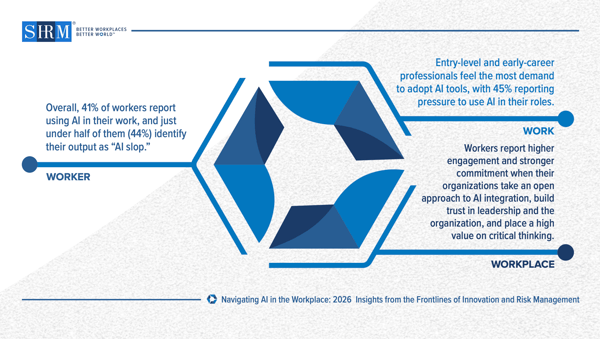 Source: SHRM, Navigating AI in the Workplace: 2026, June 4, 2026
The pressure to adapt is not distributed evenly. Forty-five percent of entry-level and early-career professionals report feeling pressure to use AI in their roles, the highest share of any career group. For younger employees trying to demonstrate their value in a tightening job market, AI may create opportunity, but it can also introduce uncertainty, heavier expectations, and a greater need for guidance from managers.
Perhaps most important for leaders, SHRM found that workers report higher engagement and stronger organizational commitment when employers take an open approach to AI integration, build trust in leadership, and continue to value critical thinking. Engagement is also stronger when organizations rely less on AI as a replacement for employee skills.
That distinction brings Link's argument into sharper focus. Giving employees access to AI is not enough.
“Workers who access AI in their workplace reported higher engagement when their organizations take an open approach to AI integration, build trust in leadership and the organization, and place a high value on critical thinking, but also rely less on AI for skills replacement,” the report notes. “Meanwhile, workers with strong organizational commitment reported greater value for critical thinking when using AI, higher overall trust in their organization, greater openness to embracing AI in their workplace culture, and less reliance on AI in their work.”
The organizations that gain the most from AI will be those that invest in their people alongside the technology.
As AI Becomes More Capable, Human Leadership Becomes More Important, Not Less
.jpg?width=450&height=450&name=LG_26-202_AI-Blog_Graphic_1200x1200%20(1).jpg)
Link believes organizations should embrace that reality rather than fear it: "I don't want people running for the hills when it comes to AI. I don't want that. I want folks grabbing this... learning it... and then using it as a superpower."
That idea represents a meaningful shift in how many organizations are approaching digital transformation.
For years, technology strategies focused primarily on efficiency and automation. Today, the conversation is expanding to include how technology can help people become better managers, stronger communicators, and more thoughtful leaders.
Derek Lundsten believes that's where organizations have an opportunity to differentiate themselves.
As AI makes information more accessible and automates routine work, leadership becomes an even greater competitive advantage. Organizations that help managers navigate ambiguity, communicate effectively, coach employees, and build trust will not only adapt to AI, but use it to strengthen their workforce.
“The future of work is not about choosing between technology and people,” said Lundsten. “It is about understanding how each can make the other better, and that is changing the conversation for HR leaders.”
Listen to the full conversation with Jim Link, Chief Human Resources Officer at SHRM, on the Rebels with a Heart Podcast. Now streaming on Apple Podcasts and Spotify.
SHRM’s People Manager Qualification + Professional Mentoring by LifeGuides (PMQ+) equips managers with practical skills to recognize employee challenges, lead with empathy, and connect team members to the right support. Through expert-led training and actionable tools, managers become more confident leaders who can strengthen wellbeing, trust, and resilience across the workplace.