For years, organizations approached leadership development with a relatively straightforward formula: identify high performers, promote them into management roles, and provide training designed to help them lead teams more effectively.
But across industries, a growing number of organizations are discovering something uncomfortable: despite increased investment in leadership training, many managers still feel overwhelmed, underprepared, and unsupported in the moments that matter most.
That tension sat at the center of a recent episode of the Rebels with a Heart Podcast featuring Alex Alonso, Chief Knowledge Officer at SHRM, alongside Derek Lundsten, CEO of LifeGuides.
Together, they explored why leadership development is evolving far beyond traditional training programs and why organizations are being forced to rethink how they support managers in practice, not just in theory.
People Managers Sit at the Center of Organizational Success
The growing focus on manager effectiveness is not simply an HR conversation. Increasingly, organizations recognize that people managers directly influence culture, engagement, retention, productivity, and long-term business performance.
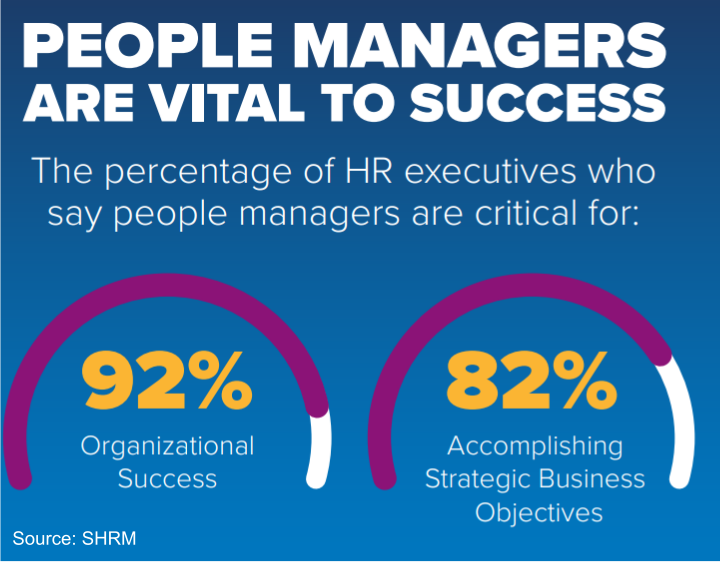
SHRM research underscores the scale of that impact. According to HR executives, 92% say people managers are critical to organizational success overall, while 82% say they are essential to accomplishing broader strategic business objectives.
As leadership expectations continue to evolve, organizations are being challenged to think differently about how managers are developed, supported, and reinforced over time.
According to additional SHRM research, 58% of managers report never receiving formal management training at all. Even among organizations that do invest heavily in leadership development, Alonso pointed to another challenge learning and development leaders increasingly recognize: training completion does not necessarily translate into behavior change.
That distinction matters more than ever.
The Growing Complexity of People Management
The challenge is not simply that managers are undertrained. Increasingly, they are operating under extraordinary pressure while being asked to navigate increasingly human-centered leadership expectations.
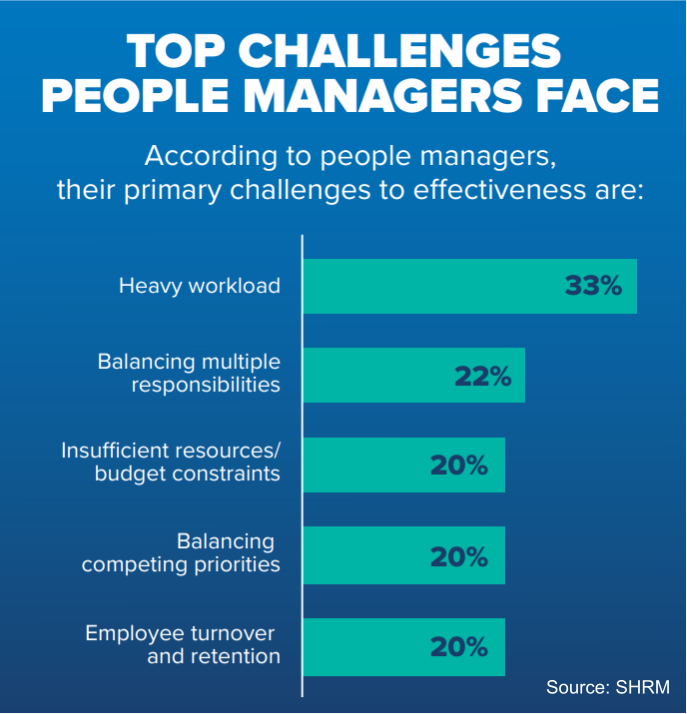
SHRM research highlights the growing complexity of the modern manager role. According to people managers themselves, some of the biggest barriers to leadership effectiveness include heavy workload, balancing competing responsibilities, budget and resource constraints, employee retention pressures, and constant prioritization demands.
As organizations continue asking managers to lead through uncertainty and change, many are recognizing that leadership effectiveness today requires far more than operational oversight alone.
Today’s managers are navigating a workplace shaped by economic uncertainty, burnout, AI disruption, shifting employee expectations, and increasingly blurred lines between personal and professional life. Employees are no longer looking to managers solely for oversight or accountability. They are looking for guidance, communication, support, and trust.
As Alonso explained in the episode, one of the biggest shifts happening in leadership development is the growing emphasis on helping managers understand employees as whole people, not simply as workers performing tasks inside an organization.
“It’s really this notion of training people how to communicate in a way that indicates that you understand their career objectives,” Alonso shared. “Not just the career objectives that happen within the organization, but long-term objectives in life.”
That subtle distinction reflects a much larger transformation happening inside organizations right now.
For decades, management effectiveness was often measured primarily through operational performance: productivity, execution, efficiency, and results. Those capabilities still matter, but they are no longer sufficient on their own. Increasingly, organizations are realizing that leadership effectiveness is deeply tied to emotional intelligence, communication, and the ability to navigate human complexity in real time.
The Power of Effective People Management
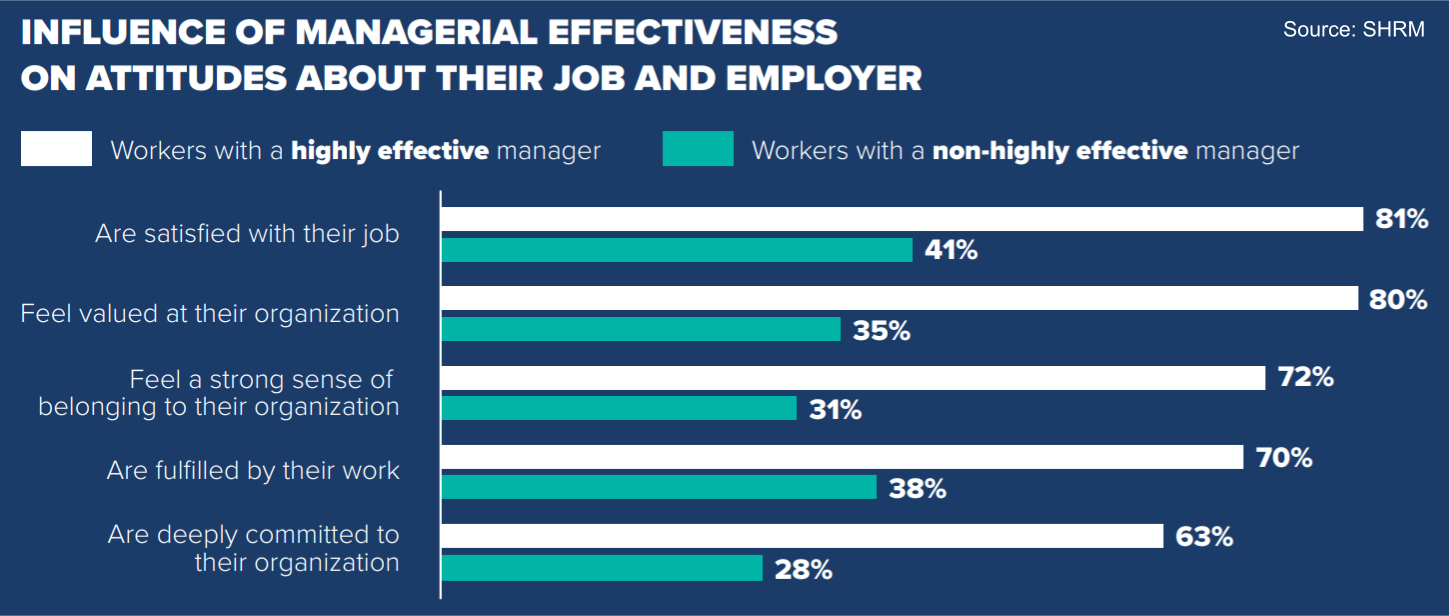
SHRM research reinforces just how significant effective managers can be to organizational culture and employee experience. Compared to their counterparts, employees with highly effective managers are nearly twice as likely to feel satisfied and fulfilled in their jobs, and more than twice as likely to feel a deep sense of commitment and belonging at their workplace.
Those outcomes are not simply culture metrics. They directly influence retention, engagement, performance, trust, and long-term organizational resilience.
And unlike technical skills, those capabilities are much harder to build through one-time workshops or static training modules.
Leadership does not happen inside a classroom. It happens in difficult conversations. It happens when an employee makes a mistake, experiences burnout, struggles with confidence, or faces challenges outside of work that inevitably impact performance and engagement. Managers are being asked to navigate situations that require empathy, adaptability, and emotional awareness, often without ongoing support systems to help them do it well.
“It sounds utterly simple,” Alonso noted, “but believe it or not, those kinds of conversations are not easy.”
Derek Lundsten believes that challenge is exactly where many organizations are getting stuck.
“We’ve spent years treating leadership development like an information problem,” Lundsten says. “But most managers don’t fail because they lacked information. They struggle because leadership is deeply human work, and human work requires reinforcement, practice, confidence, and support over time.”
That idea represents a meaningful shift in how organizations think about leadership development. For years, companies focused primarily on scaling content: more workshops, more courses, more certifications, more learning libraries. But increasingly, HR leaders are recognizing that knowledge alone does not create better managers.
One area where this shift is already taking shape is through SHRM PMQ+ Professional Mentoring from LifeGuides, a leadership development offering created in partnership with SHRM. The program combines SHRM’s People Manager Qualification (PMQ) training with one year of structured professional mentoring from LifeGuides, helping managers reinforce and apply leadership skills long after formal training ends.
The model was designed to address one of the biggest challenges organizations continue to face: translating leadership learning into sustained behavior change. Rather than treating leadership development as a one-time event, PMQ+ focuses on ongoing reinforcement, real-world application, and human support during the critical first months and years of people leadership.
Lundsten points to a scenario many HR leaders know all too well: a manager completes leadership training, leaves inspired, and genuinely wants to lead differently. But a few weeks later, deadlines are slipping, a team member is burning out, tensions are rising, and the pressure to deliver takes over. Suddenly, the manager who just learned about empathy, coaching, and psychological safety is back to rushing through 1:1s, avoiding difficult conversations, and leading from stress instead of intention.
“That’s where most leadership development breaks down,” Lundsten says. “Not because managers reject the learning, but because pressure exposes whether organizations have actually built reinforcement into the system. Human-centered leadership sounds great until people are overwhelmed, exhausted, and operating under real business pressure.”
Behavior change requires something more continuous.
“Training is important,” Lundsten says, “but managers need a place to process real situations in real time. They need support while they’re navigating conflict, uncertainty, communication challenges, and the emotional realities of leadership itself. That’s where growth actually happens.”
At the same time, the rise of AI is accelerating the importance of distinctly human capabilities in the workplace. Throughout the episode, both Alonso and Lundsten pointed to empathy, communication, and relationship-building as the skills becoming most valuable in modern leadership environments precisely because they cannot be easily automated.
“The more technology advances,” Lundsten says, “the more human leadership becomes the differentiator. Organizations that win are going to be the ones that know how to help people feel seen, supported, and connected during periods of constant change.”
What Managers Say They Need Most
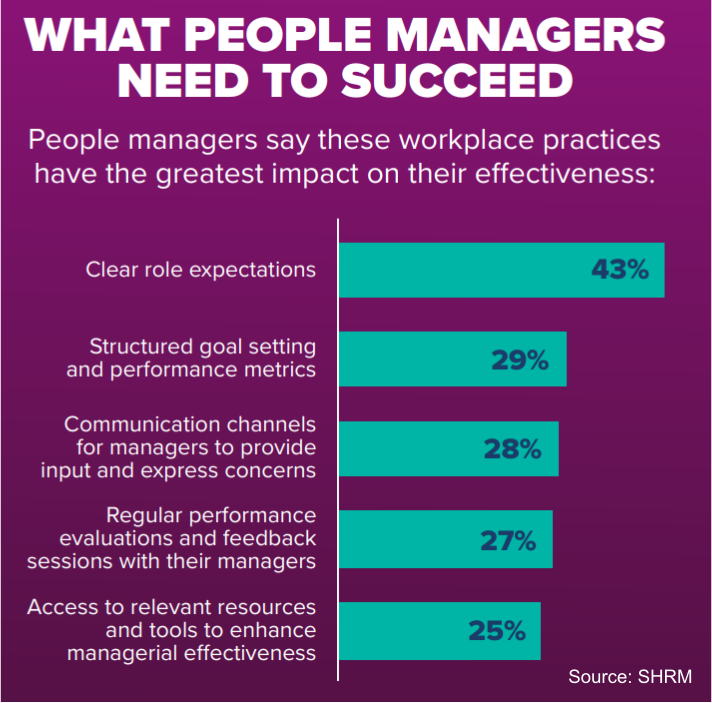
As organizations rethink leadership development, it is equally important to understand what managers themselves say has the greatest impact on their effectiveness.
According to SHRM research, people managers are not simply asking for more training. They are looking for clearer expectations, stronger communication channels, structured feedback, measurable goals, and access to ongoing resources that help them navigate the realities of leadership over time.
The findings reinforce a growing shift in leadership development strategy: managers perform best when organizations create systems of continuous support, communication, and reinforcement — not isolated learning moments.
Applying This Inside Your Organization
For organizations evaluating their leadership development strategy, the conversation raises an important question: are managers simply being trained, or are they being continuously supported as leaders?
That distinction has practical implications.
Many organizations invest heavily in leadership training, yet still struggle with inconsistent manager performance and behavior change that fades over time. Increasingly, HR and L&D leaders are recognizing that the issue is often not the training itself, but the lack of reinforcement after training ends.
Organizations looking to close the leadership gap should consider whether their current approach gives managers opportunities to practice difficult conversations in real-world settings, receive reinforcement after training programs conclude, build communication and emotional intelligence over time, and access peer support, coaching, or mentorship during challenging moments.
As you evaluate your own leadership strategy, consider:
- Are managers receiving ongoing support after training?
- Are they prepared to navigate difficult human conversations?
- Are leadership behaviors being reinforced consistently over time?
Because leadership challenges rarely emerge on a predictable schedule. They happen in moments of tension, stress, transition, and uncertainty. And increasingly, employees remember how managers showed up during those moments more than any formal initiative or organizational messaging.
“The future of leadership development,” Lundsten says, “isn’t just about building smarter managers. It’s about building more supported humans who are capable of supporting others.”
To help organizations explore these questions, LifeGuides created the Frontline Manager Gap Assessment, a short diagnostic designed to help HR and L&D leaders identify hidden reinforcement gaps that may be impacting manager effectiveness.
The organizations that adapt successfully to this shift will likely be the ones that recognize a simple but increasingly urgent truth: leadership development is no longer just about teaching managers how to drive performance. It is about helping them lead people through complexity, change, and uncertainty with empathy, communication, and trust.
And that work is far more human than many organizations were ever trained to expect.
Listen to the full conversation with Alex Alonso, Chief Knowledge Officer at SHRM, on the Rebels with a Heart Podcast. Now streaming.